SOFTWARE ENGINEER · AGENT DIRECTOR

Ralph Krausse
Pollock used a brush. I use agents.
Building software is more of an art than ever — the instruments just changed. The work has shifted from implementation to management: of agents, of markdown files, of memory, of the collaboration between them.
I ship production software by directing AI coding agents — Claude Code and OpenAI Codex. The agents do the typing. The judgment about what is correct, what scales, and what to build next is mine, backed by a career of enterprise .NET, Angular, and Azure engineering.
How I make AI think
Every feature worth shipping outgrows the context window. Instead of fighting to keep it all in the model’s head, I push the state out — into one plain Markdown plan file the agent reads back at the start of every phase.
Three small skills run on that file: one plans, one implements, one builds the whole plan unattended. The context becomes disposable; the plan keeps the agents honest.
- rpk-planInterrogates an idea into ordered, checkbox-tracked phases.
- rpk-implementBuilds one phase, verifies it, leaves it uncommitted for review.
- rpk-autobuildRuns every phase in a fresh context, one commit at a time.
Military Service
United States Marine Corps (1988 - 1993)
- Served in the 1st Persian Gulf War
- Honorable Discharge from Military Service – Rank Sergeant

- Good Conduct Medal
- Navy & Marine Corps Achievement Medal
- Sea Service Deployment Ribbon
- Navy Unit Commendation
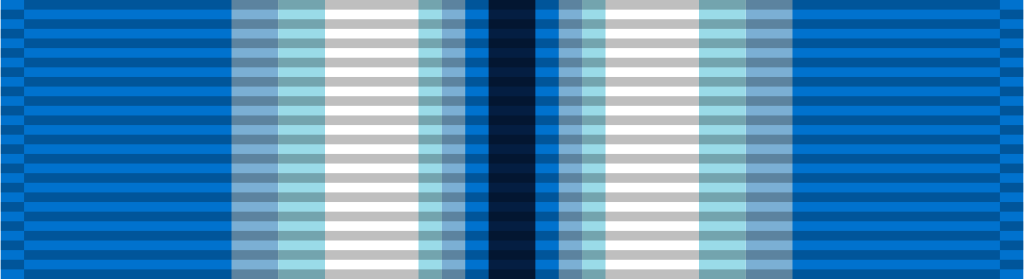
- Naval Arctic Service Ribbon
- National Defense Service Medal
- Southwest Asia Service Medal
- Navy Meritorious Unit Commendation
- Kuwait Liberation Medal








Let’s talk
Always interested in good problems, projects, and the people building them. The fastest path is email.